
EV Charging Speed Explained: What Affects Your Electric Car Charging Time?
Posted by Car Chargers on 14th Jul 2026
We are in the era of electric vehicles and smart living. As electric vehicles make a big leap onto the roads, understanding EV charging speed and charge times for electric cars is becoming more important than ever. Whether you are installing a home charger or relying on public infrastructure, knowing how charging works helps you estimate your electric car charging time and choose the right solution for your routine charging.
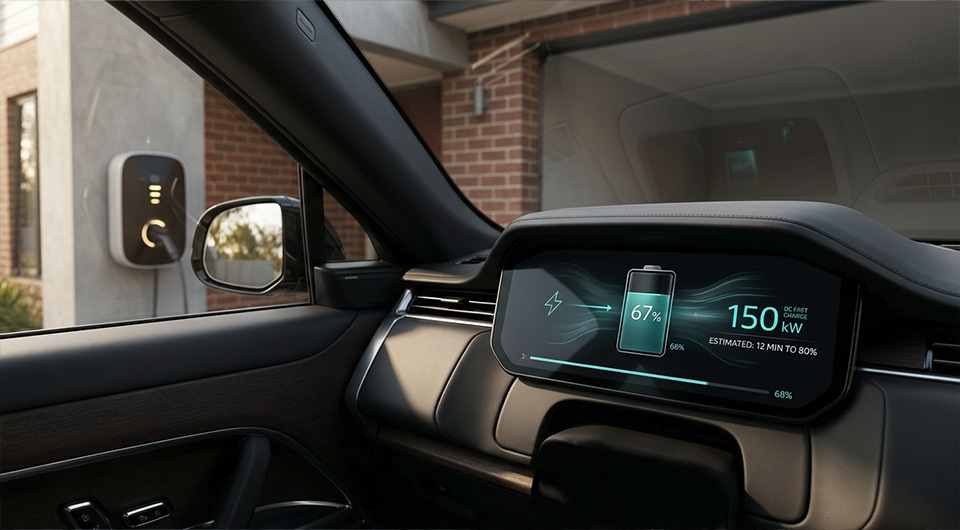
What is EV Charging and Why Speed Matters
EV charging is a simple process of supplying electricity from a power source to your vehicle’s battery. But unlike refuelling a petrol car, the charging time for an electric car or any vehicle depends on several technical factors.
The EV charging speed is measured in kilowatts (kW) and this represents how quickly energy flows into your battery. The higher the kW, the faster your EV charge time, but only up to your vehicle’s maximum capacity.
In simple terms:
kW (kilowatts) - charging speed
kWh (kilowatt-hours) - battery size
Divide the battery size by charging power, and you get a rough estimate of the charge time for an electric car.
Logic is very simple: faster EV charging speeds reduce the time spent waiting for your battery to recharge and give you more time on the road. This becomes particularly important during your busy daily routines or long-distance travel, where convenience and time matter most. If your EV takes too long to charge, such as over 24 hours on a basic charger can easily disrupt your schedule or delay your journey.
Types of Chargers and Their Charging Speeds
When discussing electric car charging comparison, chargers typically fall into three categories:
Slow Charging (Level 1)
This is the slowest option and results in the longest recharge time for electric cars. These typical Level 1 chargers can be used for occasional charging. This uses a standard household socket such as a 3-pin plug.
- Power: 2-3.5kW
- 24+ hours for full charging(longer for large batteries)
- Adds minimal range per hour
- Ideal for light daily driving
Standard/Fast Charging (Level 2)
This is the most preferred AC charging mode with Type 2 connectors at home. This can work with overnight charging and for top-ups during stops. For most users, this is the optimal balance between cost and charging speed for home EV chargers.
- Power: 7-22kW
- Common for homes and workplaces
- Allows effortless overnight charging
- Ideal for daily use
Rapid Charging (DC Fast Charging)
A rapid charger can significantly reduce electric car recharge time, often charging up to 80% in under an hour depending on the vehicle. This is also referred to as rapid charging or even speed charging, especially with newer super fast car charger technology.
- Power: 50-350 kW
- Found in public stations
- Designed for quick top-ups
Charging Speed and Power Output
It’s important to consider your home EV charger’s rated current, which typically ranges from around 16A to 50A or more. Higher amperage means greater power output and this is usually between 3.6 kW and 7 kW for most UK homes. This can significantly reduce EV charging time and make it easier to fully charge your vehicle overnight, particularly for EVs with larger batteries.
How Long Does It Take for Electric Cars to Charge?
This is one of the most common questions when you plan to buy a new electric car. But the answer varies widely according to the following situations:
Home charging: 6-12 hours
Workplace/public AC: 3-8 hours
Rapid charging: 20-60 minutes (to ~80%)
Key Factors Affecting EV Charging Time
Electric car charging time requires looking beyond the charger. Actual charge times for electric cars depend on more than just a charger. Let’s understand it better.
Battery Size - Larger batteries take longer to fill, increasing overall EV charging time.
Charger Power vs Vehicle Limit - Even if you plug into a super fast car charger, your vehicle may cap the speed.
State of Charge (SoC) - Charging slows down after 80% to protect battery health, so the last 20% takes longer.
Voltage and Amperage - Charging speed depends on the relationship: kW = (Volts × Amps) ÷ 1000
Higher voltage and current enable faster speed charging, which is why rapid charging stations operate at much higher levels.
Choosing the Right Charging Option
For most drivers, the best setup involves a mix of home and public charging. So it is recommended to use Type 2 for your daily needs and use rapid charging for long trips and quick top-ups. If you are evaluating electric car charging comparison, consider your driving habits too. Daily commuters benefit from steady overnight charging, while long-distance drivers rely more on rapid chargers.
Understanding EV charging speed helps eliminate range anxiety and makes electric car maintenance more practical. From home setups to rapid charger networks, the right infrastructure can dramatically reduce your electric car recharge time. As charging technology evolves with faster speed charging and more efficient batteries, the future points toward shorter, more convenient EV charging times across the board.